Local Real Estate News, Market Trends & Homeowner Tips

Tired of confusing national headlines? Get the real truth about the Sacramento housing market right here! Our blog is updated regularly with boots-on-the-ground local news, shifting real estate trends, and insider tips you actually need. Whether you are tracking mortgage rates, hunting for hidden gems in Elk Grove, or preparing to sell for top dollar, I’ve got you covered. Bookmark this page to stay ahead of the competition!

Sept. 18, 2025

Sacramento Housing Market: August 2025 – What's Happening Right Now?

sacramento real estate market, sacramento housing market, sacramento market update, sacramento real estate trends august 2025, sacramento real estate, sacramento homes for sale, sacramento home prices, average home price sacramento, sell my home sacramento, what is my home worth sacramento?, best time to sell in sacramento, how to sell my house fast sacramento, home value sacramento

Is the Sacramento real estate market still a whirlwind, or are things settling down? If you're looking for Sacramento homes for sale or thinking about selling your home Sacramento, our August 2025 update has the answers you need! We're seeing some interesting patterns with Sacramento home prices and how quickly properties are moving. Let's dive into the simple facts.

August 2025 Sacramento Housing Market: The Key Takeaways

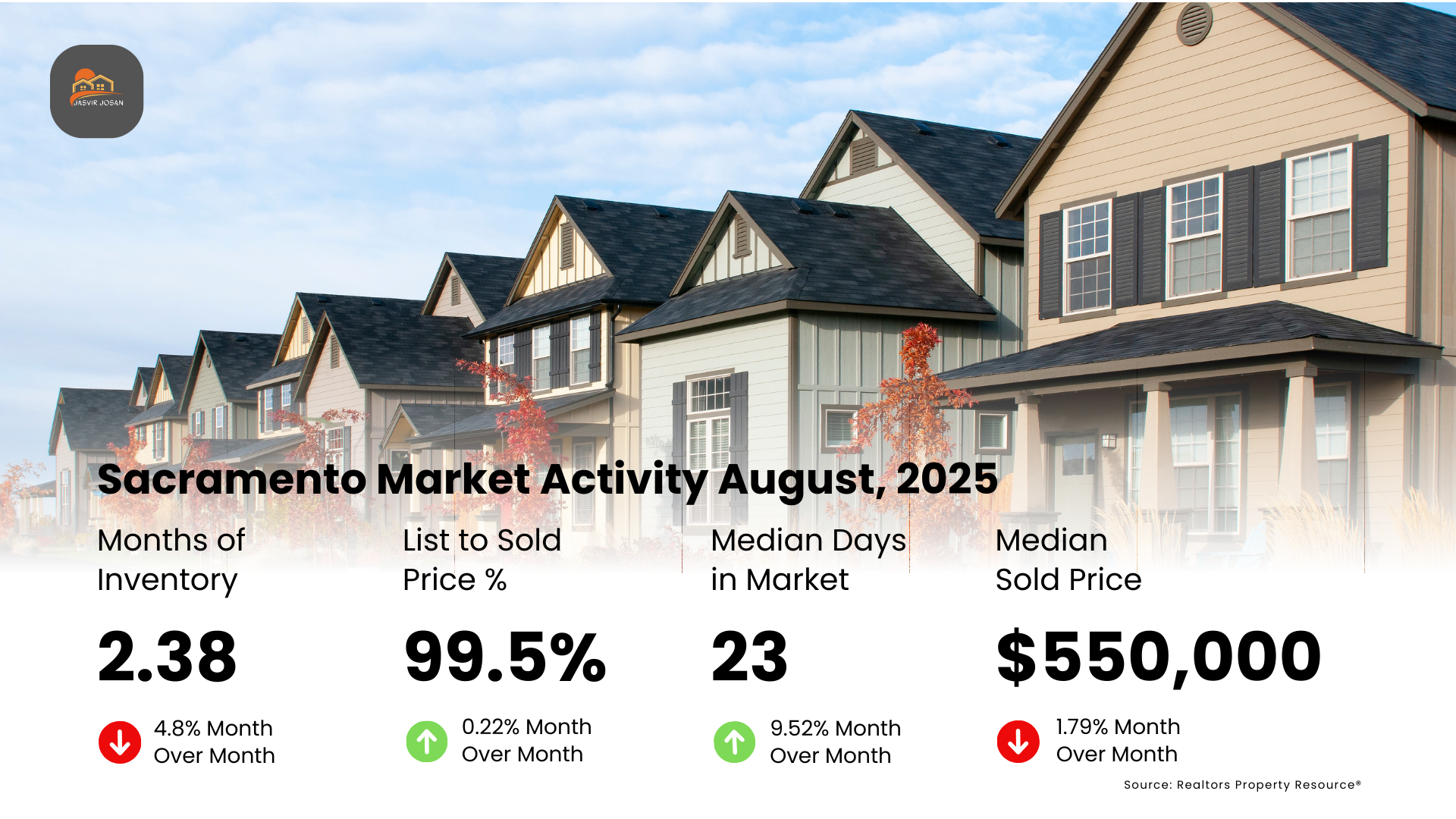
  • Months of Inventory: 2.38 (Down 4.8% from last month)
    • What this means: There are still not a huge number of homes for sale. This generally keeps the market favorable for sellers, but it's holding steady.
  • List to Sold Price %: 99.5% (Up 0.22% from last month)
    • What this means: Great news for sellers! Homes are now selling even closer to their original asking price. Buyers are confident and willing to pay for what they want.
  • Median Days in Market: 23 (Up 9.52% from last month)
    • What this means: Homes are taking a little longer to sell than last month. This gives buyers a bit more time to think things over before making an offer.
  • Median Sold Price: $550,000 (Down 1.79% from last month)
    • What this means: The average price homes are selling for has gone down slightly again. This continues to show the market is becoming more balanced.

What These Numbers Mean for You

The Sacramento real estate market in August 2025 is showing a more stable pace. It's still a "seller's market" in many ways, but with a bit more time for buyers to consider their options.

  • For Buyers: With homes on the market slightly longer, you might feel less pressure. This could be a good time to find your perfect Sacramento home.
  • For Sellers: Buyers are willing to pay close to asking price! If your home is priced correctly and looks great, you can still expect a strong sale.

Ready to Make Your Move?

Understanding these market trends is key to making smart decisions. Whether you're looking to buy a home in Sacramento or sell a house in Sacramento, I'm here to offer expert guidance. Don't navigate the market alone! Contact me today for a personalized consultation.

Posted in Market Updates
Sept. 17, 2025

What is PMI? And How It Can Help You Buy A Home Sooner!

PMI Sacramento,real estate investment Sacramento,conventional loan vs FHA,mortgage pre-approval,mortgage insurance cost, elk grove ca homes for sale, elk grove ca luxury homes, homes for sale elk grove ca, single family homes for sale elk grove ca, new construction homes elk grove ca, homes for sale sacramento ca, single family homes for sale sacramento ca, luxury homes sacramento ca, sell my house in sacramento ca, what is my home worth sacramento ca

Starting on the journey to purchase real estate in Northern California introduces you to a huge list of industry terminology and financial acronyms. One that frequently catches buyers off guard is PMI—or Private Mortgage Insurance. When you initially look at your estimated closing costs, PMI can seem like an unwanted structural hurdle. But what exactly is it? More importantly, could this single insurance mechanism actually be the strategic tool that unlocks the door to your target neighborhood years ahead of schedule?

Let's demystify how Private Mortgage Insurance works across the Sacramento region and explore why it shouldn't be viewed as a financial roadblock, but rather as an opportunistic bridge to homeownership.

What Exactly is Private Mortgage Insurance (PMI)?

In simple terms, Private Mortgage Insurance is a protective policy that insures your lender against financial loss—not you. If you apply for a standard conventional home loan and your down payment is less than 20% of the property's total purchase price, lenders require PMI to mitigate their underwriting risk.

The calculation is simple: a lower down payment means you hold less initial stake in the asset, which elevates the risk profile for the bank. PMI serves as a dedicated safety net, stepping in to absorb losses for the lender if a borrower defaults on their monthly mortgage commitments.

How Much Does PMI Cost in California?

The premium for PMI is calculated as an annualized percentage of your total loan balance and is seamlessly bundled right into your monthly mortgage check. Depending on your credit score and final loan-to-value ratio, premium rates typically fluctuate between 0.5% and 1.5% of the loan amount per year.

With median sale prices across the Sacramento housing market hovering right around $500,000, let's look at a realistic baseline example. If you take out a conventional loan for $500,000 with a standard 1% PMI rating, it will add approximately $416 per month to your baseline housing cost. While that is a noticeable added expense, it is important to weigh it against the macro-economic advantages.

The Strategic Benefits of Using PMI to Buy a Home

In highly competitive, supply-constrained real estate landscapes like Sacramento and Elk Grove, leveraging PMI can offer massive leverage for forward-thinking buyers:

  • Accelerated Market Timing: Amassing a full 20% down payment on a standard home can take years of aggressive savings. By taking advantage of low down payment programs that require just 3% to 5% down, you can purchase immediately and redirect your hard-earned income from a landlord's rent check into long-term personal wealth.
  • Capturing Neighborhood Appreciation: While you sit on the sidelines trying to save an extra $50,000 to hit that 20% mark, home values in prime areas could easily outpace your savings rate. Paying a predictable monthly PMI fee often costs far less than missing out on thousands in market appreciation. You begin capturing equity growth from day one.

How to Drop PMI From Your Loan Permanently

The absolute best characteristic of Private Mortgage Insurance is that it is explicitly temporary. Unlike government-backed FHA loans where mortgage insurance premiums often persist for the lifetime of the financing, conventional PMI can be completely eliminated. Federal laws provide direct blueprints for its removal:

  • The 80% LTV Milestone: Once your principal balance is paid down to 80% Loan-to-Value (meaning you have built 20% true equity based on the original purchase price), you have the legal right to submit a formal written request to your lender to cancel the PMI entirely.
  • Automatic Statutory Cancellation: Under the federal Homeowners Protection Act, your servicer is legally mandated to automatically terminate your monthly PMI premiums once your loan balance reaches 78% LTV of the original property value.

Furthermore, because local real estate values can experience strong historical upward trajectories, you don't necessarily have to wait decades to pay down the principal. If local market dynamics drive up your property value, you can request a new formal appraisal or look into a strategic refinancing option to prove your equity cross-section has hit that 20% mark, allowing you to drop the PMI payment early.

Related: Essential Documents Required for a Mortgage Pre-Approval

Is Paying PMI the Right Decision for Your Budget?

Ultimately, electing to pay PMI comes down to a direct calculation of time versus money. Would you prefer to pay a temporary monthly premium to anchor yourself into a long-term asset now, or wait years in a fluctuating market trying to reach a massive cash reserve limit while home prices potentially drift higher?

Are you ready to run the exact numbers for your next home purchase? Click here to browse current homes for sale in Sacramento, or connect directly with our office to analyze your credit profile and find out what your current home is worth in today's local ecosystem. Our premier real estate network will connect you with top-tier local mortgage professionals who specialize in structuring low down payment loans tailored explicitly to your long-term success.

Frequently Asked Questions About Private Mortgage Insurance (PMI)

Does PMI protect the homebuyer if they lose their job or can't pay the mortgage?

No, Private Mortgage Insurance does not protect the homebuyer. It is designed exclusively to protect the mortgage lender from financial losses if the borrower defaults and the home goes into foreclosure. If you want protection for job loss or disability, you would need to look into separate mortgage protection insurance policies.

Can I use a home appraisal to remove PMI early if my home value goes up?

Yes. If your neighborhood experiences strong market appreciation, your equity may hit the required 20% threshold much faster than scheduled. Most lenders will allow you to request PMI removal based on current market value, though they will typically require you to pay for a new official home appraisal through their approved network, and some loans require a minimum two-year payment history first.

Is PMI required on FHA or VA loans?

No, PMI is strictly a feature of conventional loans. However, FHA loans require their own version called a Mortgage Insurance Premium (MIP), which usually lasts for the entire life of the loan. VA loans do not require any monthly mortgage insurance at all, though they do require a one-time upfront funding fee at closing.

Sept. 12, 2025

Why the Off-Season is Actually the Best Season for Homebuyers

Autumn real estate market advantages for homebuyers in Greater Sacramento

Don't Fall Behind: Why Autumn Is a Great Time to Buy a Home

While the spring and summer months are traditionally labeled the "hot seasons" for real estate activity, savvy homebuyers know that the absolute best financial opportunities frequently arrive with the changing leaves. Here in Sacramento, as the autumn weather brings a welcome cool to our sunny valley days, the real estate market undergoes a significant structural shift, creating an incredibly favorable environment for motivated buyers.

If you have been on the fence about restarting your home search in Sacramento, waiting for the fall could be the smartest tactical move you make all year. Our local data highlights a cooling off from peak summer heat: the regional median sold price adjusted down by 1.82% month-over-month to $539,981. This gives you a clear, measurable advantage over the peak-season crowds.

Here are five compelling reasons why autumn is the premier hidden window to buy your home.


1. Noticeably Less Competition from Other Buyers

During the spring and summer rush, the Sacramento housing market gets flooded with buyers, particularly families racing against a tight clock to close escrow before the new school year begins. This high-stress environment routinely triggers aggressive bidding wars, waived contingencies, and listings going pending in few days.

In the fall, a massive portion of that buyer pool exits the market. With a smaller pool of active competition, the entire purchasing process becomes substantially less stressful, and your offer stands a significant better chance of capturing a seller's full attention without competing against multiple cash-over-asking bids.

2. Highly Motivated Sellers on a Deadline

Sellers who choose to list or maintain active properties on the market during autumn are rarely just testing the waters. They are almost always operating on a tight timeline. Whether they are relocating for a Q4 career transition, navigating personal life changes, or simply determined to settle into a new property before winter arrives, their motivation works completely in your favor. This motivation translates directly to:

  • Increased Pricing Flexibility: Sellers are vastly more realistic and willing to adjust their expectations to secure a firm contract.
  • Strategic Closing Concessions: You hold a much stronger position to request financial concessions, such as seller credits to buy down your interest rate, help with your closing costs, or handling deferred minor maintenance items out of pocket before the close of escrow.

3. Increased Negotiating Leverage & Processing Time

With fewer competing offers hitting a seller's inbox, the baseline leverage of the transaction moves toward the buyer's side of the table. While our current supply sits at a lean 2.29 months of inventory, properties are moving at a stable median of 22 days on the market.

This subtle pacing shift gives you the critical breathing room required to perform proper due diligence, review comparable neighborhood properties, and submit a highly customized offer without the high-pressure "act right now or lose out" panic that defines the spring market cycle.


The Autumn Advantage at a Glance

Market Feature Spring / Summer Peak Autumn / Fall Off-Season
Buyer Competition High (Frequent multiple offers) Low (Fewer active buyers)
Seller Pricing Stance Rigid / Premium expectations Flexible / More open to negotiation
List-to-Sold Ratio Frequently over asking price Stabilized at a fair 99.3%
Closing Timelines Subject to industry bottlenecks Fast, streamlined and attentive

4. A More Realistic Year-Round View of the Property

Every home looks great in bright summer sunshine surrounded by perfectly blooming flowers. However, touring a home in the autumn provides a highly accurate, realistic perspective of how the asset performs year-round.

  • True Natural Light Mapping: As the sun's trajectory lowers and daylight hours shrinks, you can see exactly how much natural lighting fills the primary living areas.
  • Authentic Landscape Assessment: You can accurately judge the condition of mature trees, perimeter drainage systems, and roof gutters as the seasons actively transition.
  • True Year-Round Curb Appeal: Seeing how a property presents on a crisp autumn afternoon helps you separate the superficial staging from the true aesthetic bones of the house.

5. A Streamlined and Efficient Closing Infrastructure

Third-party professionals—including mortgage underwriters, property appraisers, independent home inspectors, and escrow title officers—all experience a seasonal reduction in file volume following the summer rush. Because they aren't managing backlogs, your transaction benefits from:

  • Accelerated Communication: Quick responses from your entire lending and escrow support team.
  • Fewer Logistical Delays: Rapid appraisal turnarounds and zero friction scheduling specialized structural inspectors.
  • Meticulous Attention to Detail: A highly focused transaction processing experience from initial contract signing to final deed recording.

Frequently Asked Questions About the Off-Season Market

Why does the list-to-sold price ratio drop in the fall?

Our September data shows the list-to-sold price ratio dipping to 99.3%. This minor downward movement indicates that sellers are becoming more pragmatic. Instead of commanding massive premiums over list price, negotiations are settling closer to realistic, appraised values, saving buyers money upfront.

Is housing inventory high or low during autumn in Sacramento?

While the overall supply of active homes drops as casual sellers pull listings for winter, the market currently maintains a steady 2.29 months of inventory. This means that while there are fewer houses total, the quality of available listings is high, and the sellers are exceptionally serious about closing a deal.


Ready to Start Your Fall Home Search in Sacramento?

The autumn real estate climate offers unparalleled structural benefits for focused, serious buyers. By jumping back into the market when the general public hits pause, you unlock lower pricing entry points, minimal competition, and maximum transactional leverage.

I am here to guide you seamlessly through the local market dynamics and identify your primary equity opportunities. Contact our office today for a private, data-driven consultation, and let’s put you on the path to successful homeownership before the holiday season arrives!

Posted in Buyer Tips
Aug. 27, 2025

Don't Make This Major Mistake When Buying New Construction

Mistakes to avoid when buying a new construction home without a real estate agent

The Biggest Mistake When Buying New Construction (And How to Avoid It)

The attraction of a brand-new home is incredibly powerful: a completely clean slate, modern energy-efficient architecture, up-to-date color palettes, and everything functioning perfectly from day one. New construction communities are booming throughout the Greater Sacramento region, offering beautiful opportunities to design a property tailored specifically to your lifestyle.

But as you cross the threshold of a stunningly staged model home, there is one critical mistake that countless buyers make—a single misstep that can easily cost them thousands of dollars in lost concessions and valuable peace of mind: touring and registering with the community without their own independent real estate agent.

It is easy to fall into the mindset of thinking: "Why do I even need an outside agent? The salesperson sitting in the model office is incredibly friendly and helpful!" This is the single biggest misconception in the new-build arena. That accommodating representative in the sales office works exclusively for the builder's corporate entity, not for you. Their fiduciary duty is to maximize the builder's profit margin and protect the builder's interests—objectives that are often in direct conflict with your own as a buyer.

To level the playing field, you need a dedicated professional working on your side of the table from your very first visit.


The Representation Breakdown: Who Represents Whom?

  • The Builder’s Sales Representative: They are highly specialized experts on their specific inventory. They know the exact floor plans, lot premiums, design center upgrade packages, and community association rules inside and out. They are there to guide you smoothly through the builder's custom purchase agreement, but their ultimate performance is judged by how high a price and how favorable the terms they secure for the developer.
  • Your Independent Real Estate Agent: Your agent works entirely and exclusively for you. They function as your strategic advocate, legal buffer, and lead negotiator. Their sole objective is to safeguard your financial health, uncover hidden leverage, and manage the complex multi-month construction timeline on your behalf.

The Distinct Benefits of Independent Representation on a New Build

Navigating a raw dirt-to-turnkey transaction alongside an experienced Sacramento real estate advocate provides a massive list of protections:

  • Unlocking Expert Negotiation Concessions: While production builders rarely lower the base sticker price of a home (as doing so hurts the appraised value of future phases), they have substantial flexibility elsewhere. An experienced agent knows how to skillfully negotiate for substantial structural upgrades, premium appliance packages, lot premium waivers, or closing cost credits. They can also cross-compare financing incentives, like temporary interest rate buy-downs offered by the builder's in-house lender versus independent mortgage brokers.
  • Deconstructing the Builder's Contract: Standard builder purchase contracts are completely different from traditional state-approved residential agreements. They are custom-drafted corporate legal documents heavily biased toward the builder. These files often include complex clauses regarding open-ended construction delays, material cost increases passed to the buyer, and restrictive warranty frameworks. Your agent is trained to spot these financial pitfalls before you authorize the paperwork.
  • A Neutral Third-Party Advocate: Building a home from the ground up takes months, and communication boundaries can break down. If construction timelines slip unexpectedly, a finish is installed incorrectly, or disputes arise regarding design selections, your agent serves as your official point of contact. They hold the builder strictly accountable to the written parameters of your contract.
  • Coordinating Independent Home Inspections: Never skip a comprehensive home inspection just because a property is brand new! Municipal building inspectors only verify minimum structural code compliance—they do not inspect for fit, finish, or architectural craftsmanship. Your agent will coordinate an independent inspector to conduct a pre-drywall inspection (verifying framing, plumbing rough-ins, and electrical pathways before the walls are sealed) and a comprehensive final inspection prior to your official walkthrough.
  • Objective Local Market Mapping: An on-site representative is only authorized to sell you on their specific subdivision. Your personal agent possesses a birds-eye view of the entire local market. They provide an objective comparison of how that specific new build comapres against competing developments or high-end resale properties in neighboring communities, ensuring you pay true fair-market value.

⚠️ The Golden Rule of New Construction Staging: If you plan to tour any new construction community, you must bring your real estate agent with you on your absolute first physical visit, or clearly register them at the guest sign-in desk. The vast majority of builders enforce a strict procurement policy: if you cross their threshold alone, they will refuse to recognize or compensate any outside agent later in the process. This effectively strips you of your right to free professional representation.

Frequently Asked Questions About New Builds

Does hiring a real estate agent cost me more when buying new construction?

No. The compensation for your real estate agent is entirely covered by the builder via a pre-allocated corporate marketing and sales budget. Builders do not offer lower prices to unrepresented buyers who walk in alone; they simply retain that extra profit for themselves while you lose out on professional protection.

Can I use my own lender when purchasing a brand-new home?

Yes. While builders frequently offer attractive financial incentives or design center credits if you use their "preferred" in-house mortgage company, you always maintain the legal right to shop around. Your agent will help you run a side-by-side financial analysis to determine if the builder's incentive package actually beats out an independent loan structure over the long term.


Partner With a Trusted Advocate for Your New Build Journey

Building a brand-new home is an incredibly rewarding milestone. Watching your design choices transform from a blue-lined blueprint into a physical structure is unmatched. However, keeping the process stress-free and financially sound requires having the right professional team stationed firmly in your corner.

Planning to explore the newest master-planned developments across Sacramento? Do not walk into the sales offices unprotected. Connect with our team today before you start touring, and let us ensure you secure the absolute best pricing, upgrades, and contractual terms possible on your dream home!

Posted in Buyer Tips
Aug. 22, 2025

Sacramento Housing Market: Is the Tide Turning? July 2025 Update

sacramento real estate market, sacramento housing market, sacramento market update, sacramento real estate trends july 2025, sacramento real estate, sacramento homes for sale, sacramento home prices, average home price sacramento, sell my home sacramento, what is my home worth sacramento?, best time to sell in sacramento, how to sell my house fast sacramento, home value sacramento

Are you wondering what's happening with Sacramento homes for sale? The Sacramento real estate market is still a hot topic, and July 2025 brought some interesting changes. If you're thinking of buying a home in Sacramento or wondering how to sell your home in Sacramento, this simple guide will help you understand the latest trends and what they mean for you. Let's break down the key numbers!

July 2025 Sacramento Housing Market: The Main Points

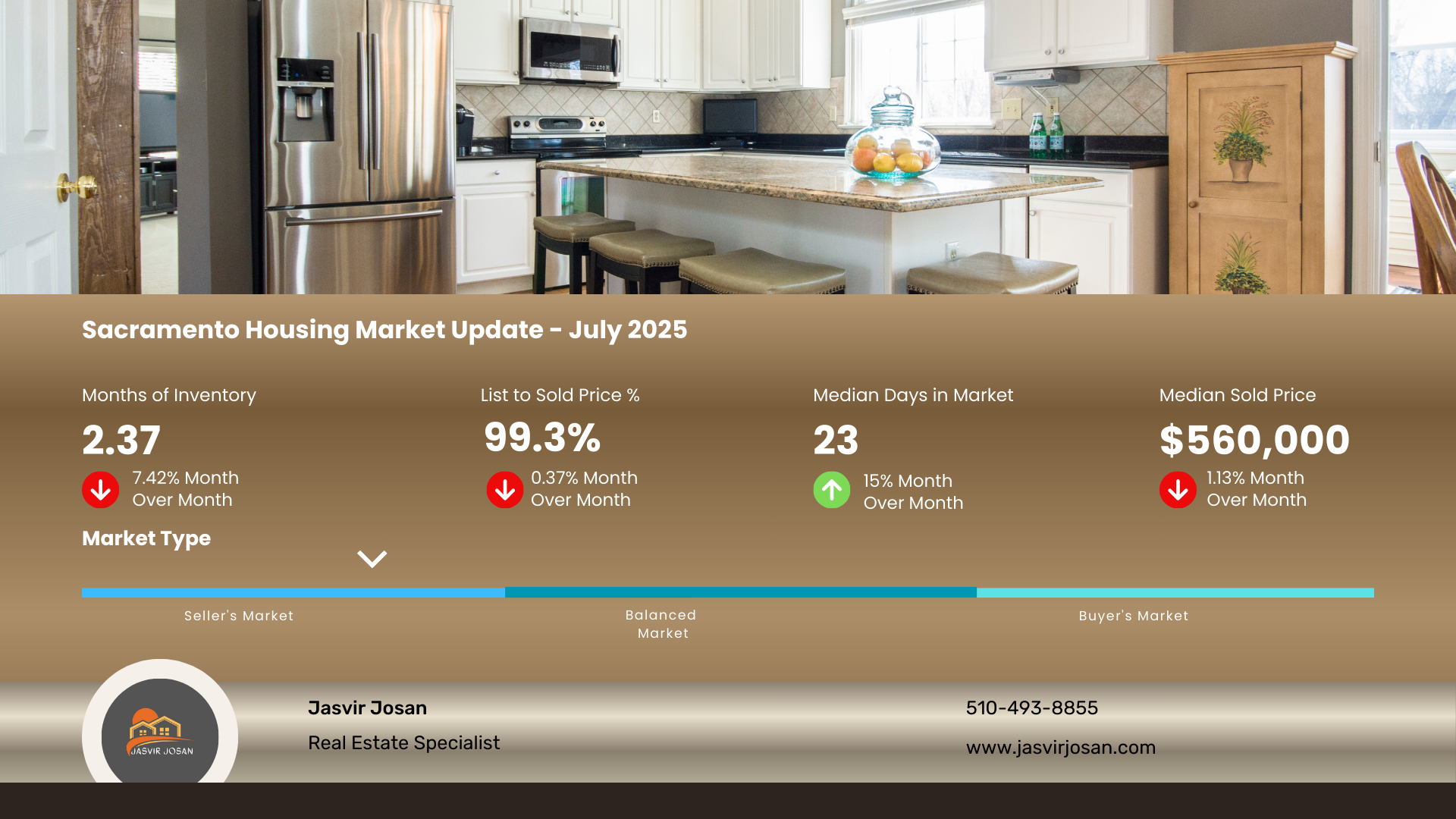
  • Months of Inventory: 2.37 (Down 7.42% from last month)
    • What this means: There are fewer homes for sale this month. This still gives sellers the advantage.
  • List to Sold Price %: 99.3% (Down 0.37% from last month)
    • What this means: Homes are still selling very close to their asking price. Buyers are still willing to pay what sellers are asking.
  • Median Days in Market: 23 (Up 15% from last month)
    • What this means: Important change! Homes are taking a bit longer to sell. This gives buyers a little more time to make a decision.
  • Median Sold Price: $560,000 (Down 1.13% from last month)
    • What this means: The average price of homes sold has dropped slightly. This could be a sign of the market balancing out.

What These Numbers Mean for You

The Sacramento real estate market is still a seller's market, but it's not as fast-paced as it was. The slight dip in prices and the increase in time on the market could be good news for buyers.

  • For Buyers: You might have a bit more time to find your perfect home and could see less intense competition.
  • For Sellers: It's still a great time to sell, but pricing your home correctly and making it look its best is key to getting a quick sale.

Ready to Make Your Move?

The Sacramento real estate market can be tricky to navigate on your own. I'm here to help you understand these trends and make the best decision for your family. Whether you want to buy a home in Sacramento or sell a house in Sacramento, let's talk about your goals!

Posted in Market Updates
Aug. 13, 2025

Who Are the Important People on Your Side in Real Estate

The essential professional team required for a successful real estate transaction

You have officially made the choice to buy or sell a home in the Greater Sacramento region—that is a monumental decision and an incredibly exciting milestone! As you begin this journey, you will quickly realize that navigating a modern property transaction is never a solo mission. A truly successful, legally sound real estate closing is a highly coordinated team effort. Surrounding yourself with the right professionals is the ultimate key to a smooth, protected, and stress-free experience.

Think of your real estate transaction team as your personal council of guides, each with a specific, highly technical area of expertise to guide you safely through the escrow process. Their combined objective is to completely protect your financial interests, insulate you from legal liability, manage complex logistical timelines, and ultimately help you achieve your homeownership goals.

Here is your detailed introduction to the important people standing on your side of the table in a real estate transaction and exactly what they achieve for you.


The Real Estate Core Team at a Glance

Team Member Primary Focus Key Benefit to You
Real Estate Agent Strategic project manager & lead negotiator Protects your overall equity, targets listings, and drafts legal terms.
Mortgage Lender Financial structural underwriting Secures loan funding, optimizes interest rates, and issues pre-approvals.
Home Inspector Physical and structural evaluation Uncovers hidden material defects and provides repair leverage.
Home Appraiser Independent third-party asset valuation Ensures the property's actual worth justifies the underlying mortgage contract.
Title & Escrow Officer Neutral funds management & deed recording Guarantees clean title transfer and safely holding earnest money deposits.

1. Your Real Estate Agent: The Field Quarterback

This is your primary baseline point of contact, your strategic advisor, and your contract advocate. A premier real estate agent is far more than a simple transaction salesperson—they are local market economists, defensive contract writers, and logistical coordinators rolled into a single representative.

  • For Home Buyers: Your agent works closely with you to isolate your lifestyle needs, search for qualified inventory, arrange private property viewings, and creates competitive purchase offers. They utilize hyper-local insight regarding specific Sacramento neighborhoods to help you discover the ideal fit while steering you away from over-priced listings.
  • For Home Sellers: Your agent generates highly accurate, real-time comparative market analyses to establish a pricing strategy that maximizes your final net proceeds. They coordinate high-end digital marketing campaigns, screen incoming buyer profiles, and seamlessly negotiate multi-offer scenarios to secure your preferred terms.

2. Your Mortgage Lender: The Financial Architect

Your mortgage lender is the financial expert who structures and secures the capital required for your residential property purchase. Aligning with an incredibly responsive, highly reputable lender is a critical initial milestone that should take place long before stepping inside an open house.

  • The Power of True Pre-Approval: A skilled loan officer will navigate you through a formal mortgage pre-approval process, analyzing your tax returns, credit scores, and asset portfolios. Walking into a transaction with an official pre-approval letter signals to sellers that your financial profile is fully verified and stable.
  • Tailoring Your Debt Profile: They will break down different, highly complex loan structures to determine the absolute cleanest fit for your specific lifestyle, tracking various programs including conventional, FHA, or specialized VA loans.
  • Clearing the Underwriting Milestone: Once a purchase agreement is ratified by both parties, your lender works tirelessly behind the scenes to verify files, clear conditions, and issue the final "clear to close."

3. The Home Inspector: Your Objective Eyes and Ears

For buyers, skipping a professional home inspection is a catastrophic financial risk. An inspector's core duty is to provide an entirely objective, incredibly deep, and unbiased forensic evaluation of a property's current physical health.

  • The Structural Blueprint Review: A licensed inspector will carefully examine the home's primary systems, including the roof, concrete foundation stability, HVAC functionality, electrical wiring panels, and primary plumbing mainlines. They package their findings into a clear, detailed photographic report outlining everything from minor cosmetic touch-ups to severe structural failure.
  • Unlocking Financial Counter-Leverage: The comprehensive data provided inside an inspection report serves as your ultimate negotiating chip. It empowers your agent to safely demand targeted seller repairs, structure substantial price drops, request closing cost credits, or walk away entirely with your deposit fully intact if the physical defects are too extensive.
  • Local Deficiencies Competency: Top-tier local inspectors understand specific regional nuances, such as typical foundation settlement patterns caused by local clay soils or specific wood-destroying pest vulnerabilities common to older valley builds.
Pro-Tip for Transactions: The home inspector evaluates the condition of the house, whereas the appraiser evaluates the value of the house. Both are critical protection checkpoints, but they serve completely different purposes.

4. The Home Appraiser: The Independent Valuator

The home appraiser is a completely independent, neutral third-party professional retained by the lending institution. Their responsibility is to deliver a completely unbiased valuation of the real estate's fair market value.

  • Insulating the Financial Investment: Banks are legally restricted from lending more money than a physical asset is worth. The formal appraisal ensures the underlying home value cleanly justifies the mortgage loan amount, protecting the bank's security position and keeping you from overpaying.
  • Data-Driven Calculations: Appraisers rely heavily on highly standardized criteria, comparing recent closed neighborhood sales (comps), current structural square footage, lot location dynamics, and visible upgrades. The final value calculation must land at or above the agreed contract price for financing to remain on schedule.

5. The Title & Escrow Officer: The Neutral Security Safe

In the state of California, your escrow officer operates as an entirely neutral, non-biased intermediary who securely holds all institutional funds, earnest money deposits, and legal instruments associated with the transfer of ownership.

  • Safeguarding Earnest Deposits: The escrow officer maintains your sensitive financial deposits inside an independent, secure escrow account. No capital moves without strict, mutually signed authorizations matching both the buyer and seller instructions.
  • Managing Title Security & Official Recording: Simultaneously, the title department conducts extensive historical title searches to guarantee the seller has the clean legal right to transfer the home, ensuring the property is free of hidden mechanics liens, tax judgments, or boundary disputes. Once everything aligns perfectly, the escrow officer orchestrates the distribution of funds and registers the new deed directly with the county recorder's office.

Frequently Asked Questions About Real Estate Teams

Can I choose my own title and escrow company?

Yes. In a standard California purchase contract, the choice of the title and escrow provider is completely open to negotiation between the buyer and the seller. Typically, local customs or specific negotiations dictate which premier firm is written into the final agreement to manage the closing timeline.

How do I know if the professionals I hire are reputable?

The safest strategy is to rely on your real estate agent's vetted professional network. Experienced local agents close dozens of transactions a year and maintain pre-screened relationships with the most thorough inspectors, reliable loan officers, and efficient escrow managers in the region.


Your Dream Team is Ready to Secure Your Success

Navigating the active, fast-paced Sacramento real estate landscape is filled with complex legal requirements, strict contractual timelines, and substantial financial weight. You should never feel forced to take on these milestones unsupported. Building a fortified team of elite, hyper-focused professionals is the single smartest decision you can make for your household's wealth.

Ready to kickstart your real estate journey alongside the best professional team in the valley? Let's connect today for a personalized, data-backed strategy session. We will connect you directly with premier local lenders, meticulous home inspectors, and elite escrow teams to guarantee your real estate transition is flawlessly managed from day one! Contact us today to get started!

July 30, 2025

What Documents Do I Need To Get Pre-Approved for a Mortgage?

Essential financial documents required for mortgage preapproval checklist

Introduction: Preparing for Your Ultimate Homebuying Power Move

It is an incredible milestone when the dream of buying a home transitions from an abstract thought into a real, actionable strategy. One of the absolute first, and most defining, steps you can take to solidify this journey is securing a formal mortgage pre-approval. This isn't just a basic administrative formality; it is a highly influential asset that proves to home sellers and listing agents that you are a serious, financially vetted buyer ready to close quickly.

But what exactly do underwriting lenders need to review when you submit your file? While the prospect of digging through historical financial archives can feel a bit daunting, the process is incredibly straightforward once you break it down by category. Getting organized ahead of time will insulate you from transactional delays and eliminate stress down the line!


The Master Pre-Approval Checklist at a Glance

Before diving into the fine details, use this quick-reference summary table to organize your digital files:

Document Category Standard W-2 Employee Requirements Self-Employed / Special Rules
1. Identity & Residence Valid Driver's License/Passport, SSN Card 2-year formal residential address history
2. Income Verification Last 30 days of pay stubs, 2 years of W-2s 2 years of corporate tax returns, YTD Profit & Loss, 1099s
3. Asset Verification 2-3 months of standard bank statements (all pages) Quarterly 401(k)/IRA portfolios, signed down payment gift letters
4. Liabilities & History Standard credit pull authorization Recent monthly statements for auto, student, or personal debt lines

Why Do Lenders Require This Volume of Paperwork?

The underlying reason is simple: Underwriters are legally tasked with verifying your "Ability to Repay" the prospective home loan. By conducting a forensic review of your historical financial footprint, they analyze your baseline income stability, your historical track record with revolving credit, and your overall liquid net worth. This verification process sets a definitive boundary for exactly how much capital they can safely lend you.


Your Comprehensive Pre-Approval Checklist

Having these exact items indexed and saved into a secure digital folder allows top-tier mortgage partners to review your file and issue a formal pre-approval letter in a matter of days.

1. Proof of Identity & Legal Residence

Lenders must verify your legal identity and establish fraud prevention protocols right out of the gate.

  • Government-Issued Photo Identification: A current, unexpired state driver's license, military ID, or federal passport.
  • Taxpayer Identification: Your physical Social Security Card or official Individual Taxpayer Identification Number (ITIN).
  • Residential Records: A complete list of your physical living addresses spanning the trailing 24 months.

2. In-Depth Income & Employment Verification

Lenders prioritize consistent, predictable revenue streams above almost everything else.

  • Recent Pay Stubs: Your most recent consecutive 30 days' worth of earnings records (showing year-to-date running totals).
  • W-2 Tax Statements: Signed W-2 forms for the past two consecutive tax years from all associated employers.
  • Federal Tax Filings: Complete, executed personal federal tax returns (Form 1040) along with all attached schedules for the past two years.
💡 Note for Self-Employed & Independent Contractors: If you operate as a business owner or 1099 contractor, prepare for enhanced underwriting. You will typically need to present two years of complete corporate tax returns (1120-S or 1065), a signed year-to-date Profit & Loss (P&L) statement, a current corporate balance sheet, and consecutive business bank statements to verify cash flow stability.

Alternative Revenue Streams: Remember to gather certified documentation if you claim bonus structures, commission splits, child support payouts, alimony, retirement pensions, or structural Social Security benefits (award letters must prove these funds will continue for at least three years).

3. Liquid Asset Documentation

Lenders must ensure you possess clean, verifiable liquid capital to cover your down payment obligations and escrow closing costs, while still maintaining emergency cash reserves.

  • Comprehensive Bank Statements: Two to three months of consecutive checking and savings statements. Crucial step: Provide every single page, including blank filler pages. Underwriters scan these looking for large, unvouched cash injections or sudden liquid drawdowns.
  • Investment & Retirement Portfolios: Your latest quarterly statements tracking 401(k) accounts, traditional or Roth IRAs, mutual funds, or individual brokerage trading platforms.
  • Down Payment Gift Letters: If a portion of your asset pool is being provided by a family member, you must supply a formalized, signed gift letter explicitly stating the funds are a non-repayable gift, accompanied by the donor's bank trail to track the source of capital.

4. Outstanding Debt & Revolving Liability Information

This category maps your Debt-to-Income (DTI) ratio, allowing lenders to see how much of your monthly income is already allocated to existing debts.

  • Authorized Credit Screening: While the lender conducts their own automated tri-merge credit pull, checking your profile beforehand ensures zero reporting surprises.
  • Installment Account Verification: Up-to-date statements for active auto loans, student financing lines, personal installment products, or revolving credit card accounts.

5. Specialized Circumstance Paperwork

  • Verified Rental History: If you are transitioning out of a rental agreement, some underwriters require proof of consistent rent payments (canceled checks or direct bank ledger transfers) alongside direct landlord contact details for the last 12 to 24 months.
  • Legal Disclosures: Certified court paperwork or divorce decrees outlining legally binding child support or alimony payment structures.
  • Historical Real Estate Records: Your current mortgage statement, active hazard insurance declarations, and property tax assessments if you currently own other real estate assets.
  • Legal Discharges: Formal discharge papers and structural explanations if your financial history includes a past bankruptcy or home foreclosure timeline.

Frequently Asked Questions About Pre-Approval Paperwork

How long is a mortgage pre-approval letter valid?

In most traditional lending frameworks, a formal pre-approval letter is active for 60 to 90 days. Because your financial documents age and credit scores update, lenders will simply require a fresh set of pay stubs and bank statements to extend the timeline if your home search carries longer.

What is the difference between pre-qualification and pre-approval?

Pre-qualification is a surface-level estimate based purely on unverified information you provide verbally. Pre-approval is a firm, formal commitment where an underwriter physically audits your tax returns, credit reports, and asset sheets, putting you in a vastly superior negotiating position.


Why Early Pre-Approval is Your Ultimate Advantage

Stepping out to begin looking at homes with an active pre-approval letter completely alters your homebuying experience. It establishes a rock-solid, non-negotiable budget boundary, validates your purchasing capability to prospective home sellers, and drastically accelerates your closing timeline once your contract is accepted.

Ready to get your financial profile perfectly organized for the active market? Organizing your paperwork is your first major step toward long-term wealth. Let's make sure it's handled flawlessly. Contact our office today! We work hand-in-hand with top-tier local mortgage lenders who will guide you through the underwriting process with maximum efficiency, positioning you to secure your perfect home safely!

Posted in Buyer Tips
July 23, 2025

5 Benefits To Owning Your Own Home in Sacramento!

The long-term financial and personal benefits of owning a home in Sacramento

For generations, homeownership has stood firmly as a cornerstone of the American dream. Here in the diverse and thriving Greater Sacramento region, that dream holds an even deeper appeal! While the journey to saving a down payment and ultimately buying a home requires a significant effort, the long-term rewards are huge—offering far more security, financial leverage, and pride than a simple rental agreement ever could.

Whether you are currently renting a property and considering making the tactical leap into the market, or you are a long-time resident reflecting on the true value of your asset, it is worth exploring the profound advantages of owning your own home. Let’s dive into the five key advantages that make real estate ownership one of the smartest and most fulfilling financial decisions you can make in Sacramento.


A Clear Comparison: Renting vs. Owning in Sacramento

To see how a property purchase reshapes your long-term balance sheet compared to a standard lease, consider this quick-reference breakdown:

Financial & Lifestyle Feature Renting a Property Owning Your Home
Wealth Accumulation Zero (100% of your capital builds your landlord's equity) High (Builds personal net worth via principal paydown & appreciation)
Payment Predictability Vulnerable to annual landlord rent increases Locked-in fixed principal and interest for 15 or 30 years
Tax Deductions None available to the tenant Substantial (Mortgage interest, property taxes, capital gains exclusions)
Creative Freedom Strict limitations on paint, updates, and pets Absolute control to remodel, landscape, and personalize

1. Building Multi-Generational Wealth Through Equity

When you write a check for rent, that capital leaves your pocket forever, working exclusively to pay off someone else's mortgage. However, when you own your home, every single monthly payment acts as a forced savings plan that directly builds your personal net worth. This process is known as capturing home equity.

  • The Mechanics of Equity: Equity represents the true dollar portion of the real estate asset that you fully own. It is calculated by taking the current market value of your property and subtracting your outstanding mortgage balance.
  • The Dual Growth Engine: Your equity compounds through two channels: as you systematically reduce your loan balance each month, and as the Sacramento housing market historically trends upward over time.
  • A Versatile Financial Safety Net: Accumulated home equity is a highly functional financial resource. Over time, it can be tapped responsibly via home equity lines of credit (HELOCs) or strategic cash-out refinances to fund home additions, launch businesses, or anchor retirement goals.

2. Capturing Significant Tax Advantages

The American tax code is inherently designed to reward and incentivize homeowners, providing key write-offs that keep more hard-earned cash inside your bank account annually.

  • The Mortgage Interest Deduction: For standard home purchases, the interest you pay on your mortgage can be deducted directly from your taxable income. This provides massive relief during the initial years of your loan term, when interest represents the largest chunk of your monthly allocation.
  • Strategic Property Tax Breaks: Sacramento homeowners can typically deduct state and local property taxes (SALT) up to federally mandated thresholds, directly optimizing end-of-year tax exposure.
  • The California Homeowners’ Exemption: If you occupy the property as your primary residence, you are eligible to file for our unique local California exemption. This lowers your home’s baseline assessed value by $7,000, creating an automatic, permanent discount on your annual property tax bill.
📋 Tax Planning Note: Tax laws contain specific nuances based on filing status and overall income profiles. To ensure you are fully maximizing your write-offs, always partner with a licensed Certified Public Accountant (CPA) to customize your filing strategy!

3. Stability and Long-Term Cost Predictability

Renting exposes you to constant housing insecurity. Landlords can adjust rents upward at the end of a lease cycle, force sudden move-outs if they choose to liquidate the asset, or price you completely out of a beloved neighborhood. Owning completely eliminates this volatility.

  • Locking in Your Budget: Securing a standard fixed-rate mortgage payment guarantees that your core principal and interest costs remain exactly the same for the entire 15- or 30-year lifecycle of the debt. This permanent predictability takes the guesswork out of household budgeting.
  • The Ultimate Inflation Shield: As inflation drives up consumer goods, services, and local rental rates across the valley, your fixed housing payment remains stable. Over a multi-year timeline, your home expenses actually become relatively more affordable in comparison to your growing earning power.

4. Complete Freedom to Personalize and Control Your Space

The non-financial, psychological rewards of owning your own land are just as powerful as the economic metrics. Your home is an authentic expression of who you are.

  • Unrestricted Customization: Want to take down an interior wall to build an open-concept living space? Eager to modern-stage your kitchen cabinets, plant an expansive backyard organic garden, or install custom hardwood floors? You hold absolute creative authority without ever waiting around for a landlord's permission.
  • Escaping Arbitrary Rules: Say goodbye forever to restrictive pet deposits, strict limits on animal weights, drilling limitations, and intrusive structural inspections. You establish the house rules.

5. Putting Down Deep Roots and Cultivating Community

Homeownership is the primary catalyst for long-term social stability, fostering deep neighborhood connections and a true sense of local belonging.

  • Hyper-Local Engagement: Because homeowners tend to remain in place much longer than transient renters, they build meaningful, lifelong relationships with neighbors. They become actively invested in supporting local schools, neighborhood safety watch initiatives, and community parks throughout established Sacramento neighborhoods.
  • Targeted Suburban Foundations: Whether you anchor your family in the top-tier school districts of Elk Grove, settle into the modern, master-planned developments of Natomas, or embrace the timeless architectural character of historic East Sacramento, owning a home provides an invaluable foundation of consistency for growing families.

Frequently Asked Questions About Local Homeownership

How long should I plan to stay in a home to ensure buying beats renting?

As a general rule of thumb in the Sacramento market, if you plan to remain in a specific geographic area for at least 3 to 5 years, buying almost always outperforms renting. This "break-even" window allows your property value to appreciate sufficiently to offset your initial closing costs while steadily building equity.

Are there local programs available for first-time buyers in Sacramento?

Yes. Buyers across Sacramento have access to excellent state and local assistance structures, including down payment grant programs through the California Housing Finance Agency (CalHFA). These initiatives make crossing the bridge from renter to homeowner much more accessible than many assume.


Ready to Start Building Your Financial Future?

Transitioning from renting to owning is an empowering lifestyle shift. It represents a conscious move away from funding someone else's retirement portfolio and toward securing your own household’s long-term financial freedom.

Curious about exploring your purchasing power in the current Sacramento market? Let’s look at the options together. Contact our office today for a private, personalized strategy consultation. I am here to guide you step-by-step through the process, ensuring you capitalize on every single wealth-building advantage homeownership has to offer!

Posted in Buyer Tips
July 17, 2025

Sacramento Real Estate: June 2025 Market Update – What's Happening Now?

Is the Sacramento real estate market still on fire, or are things cooling down? June 2025 brings some interesting new numbers, and if you're looking for Sacramento homes for sale or thinking about how to sell my home Sacramento, you'll want to read this! We're seeing some shifts, so let's dive into the latest on Sacramento home prices and what it means for you.

June 2025 Sacramento Housing Market: Quick Look

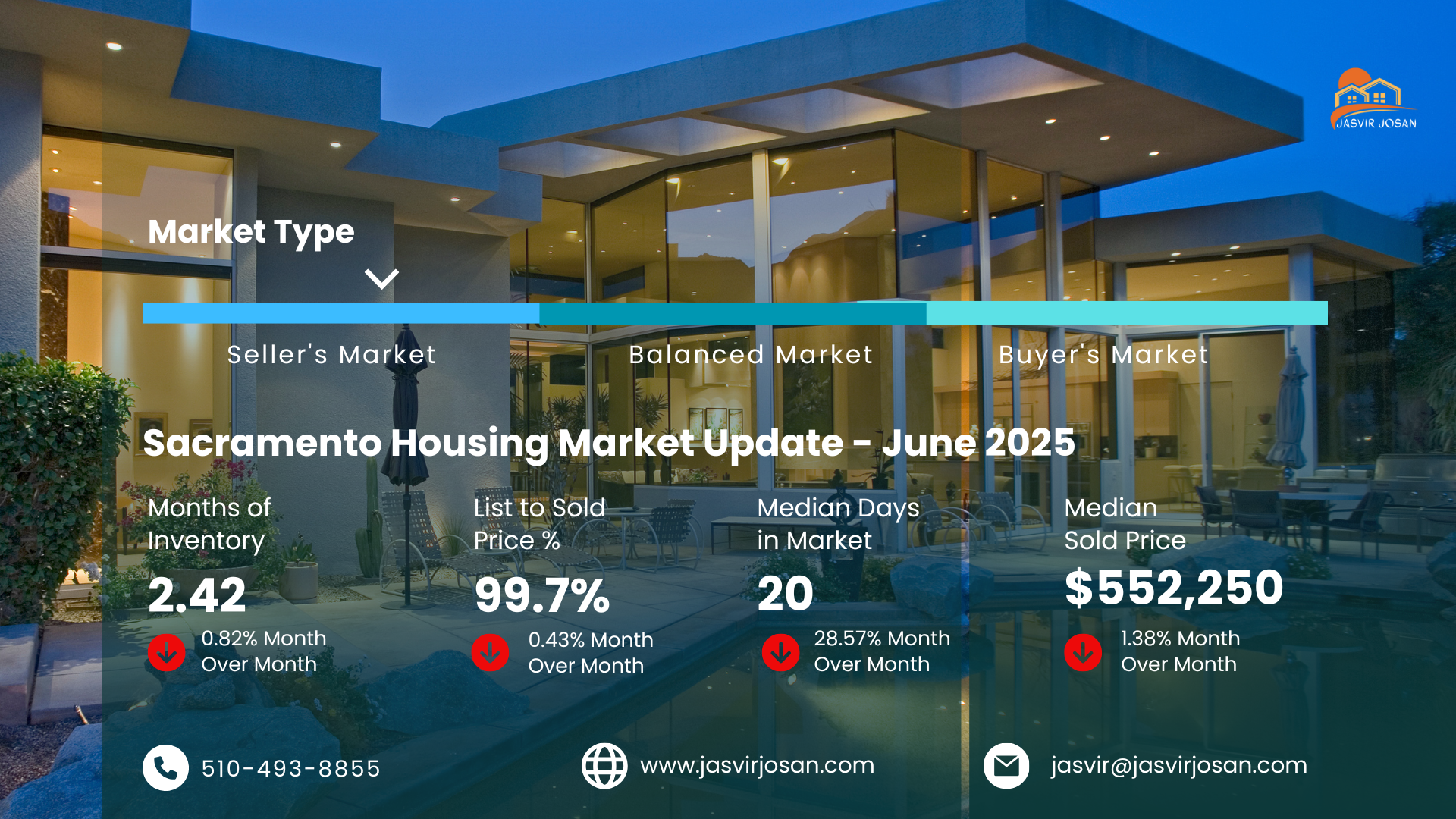
  • Months of Inventory: 2.42 (Slightly Up Month Over Month)
    • What this means: There are a few more homes on the market now compared to last month. This gives buyers a little more choice, but it's still a market where sellers have an advantage.
  • List to Sold Price %: 99.7% (Slightly Down Month Over Month)
    • What this means: Homes are still selling very close to their asking price. This means buyers are still willing to pay what sellers are asking, though it's not quite as high as before.
  • Median Days in Market: 20 (Down 28.57% Month Over Month)
    • What this means: Big news here! Homes are selling much, much faster in June than they were in May. This shows that buyers are jumping on good opportunities quickly.
  • Median Sold Price: $552,250 (Down 1.38% Month Over Month)
    • What this means: The average price homes are selling for has gone down a little bit again. This suggests prices might be settling after a long period of big increases.

What These Numbers Mean For You

  • If You're Buying a Home in Sacramento: The faster selling times mean you need to be ready to act fast when you find a home you like. Get your finances in order and be prepared to make quick decisions. The slight dip in prices might offer a small window for a better deal.
  • If You're Selling Your Home Sacramento: Homes are moving quickly! This is good news for sellers. Make sure your home is priced right and looks its best to attract those fast-moving buyers.

Ready to Make Your Move in Sacramento?

The Sacramento real estate market is always changing. Knowing these numbers helps you make smart choices. Whether you're ready to buy a home in Sacramento or looking to sell a house in Sacramento, I'm here to guide you through every step. Let's chat about your goals!

Posted in Market Updates
July 16, 2025

When To Begin Your Home Search: Your Sacramento Real Estate Timeline

Sacramento neighborhoods, Sacramento housing market forecast, Midtown Sacramento homes, Sacramento real estate market trends, Sacramento real estate agent, Folsom homes for sale, Elk Grove real estate

The thought of discovering your next perfect home, or carefully preparing your current Sacramento property for its next chapter, is incredibly exciting! But once that creative spark ignites, one of the first questions that routinely surfaces is: When should I actually start looking at houses? It is a fantastic question, and the answer isn't a single fixed calendar date. Instead, your ideal start date is a customized blend of personal readiness, intentional financial preparation, and an understanding of our unique local market cycles.

Forget the old narrative that there is a single, identical "perfect" moment that applies uniformly to every buyer. Your ideal starting window is entirely unique to your life. Let's explore the core pillars that determine exactly when it is time to launch your home search in Sacramento.


The Ideal Home Buying Milestone Timeline

To help visualize the entire roadmap, here is how a healthy, stress-free home buying journey generally breaks down chronologically:

Timeline Window Primary Objective Key Action Items
6 to 12 Months Out Financial Foundation & Discovery Audit your credit scores, optimize debt-to-income, and accumulate down payment liquid cash reserves.
3 to 6 Months Out Professional Alignment & Strategy Partner with a local agent, establish neighborhood wishlists, and gather paperwork for mortgage underwriters.
2 to 3 Months Out Formal Approval & Active Touring Secure a formal pre-approval letter, begin private home tours, and actively analyze active market inventory.
1 to 2 Months Out Contract Ratification & Escrow Submit formal offers, complete structural home inspections, finalize loan underwriting, and record your deed.

1. Personal Readiness & Life Milestones

Your lifestyle requirements are the true factor for any real estate transaction. Major life transitions are often the clearest indicators that your housing needs are shifting:

  • Changing Life Dynamics: Milestones such as expanding your immediate family, planning a wedding, or transitioning into an empty-nest phase naturally change your square-footage preferences. Career relocations into the tech and business hubs of Sacramento or a desire to move closer to multi-generational family networks are also massive indicators.
  • Your Current Lease or Sale Cycle: Is your current rental agreement set to expire in the coming months? Do you need to coordinate a simultaneous transaction where you sell your existing Sacramento home before you can safely buy your next one? Correctly organizing these contracts is highly critical.
  • Emotional Alignment: Buying or selling a home is an emotional and energetic journey. Being mentally prepared to tour properties, process contract items, and navigate strategic negotiations is just as important as your financial capacity.

2. Financial Preparation: The Non-Negotiables

For modern homebuyers, preparing your capital layout is an absolute prerequisite that requires advanced planning. This is where your journey technically begins:

  • Down Payment & Closing Capital Reserves: Your down payment allocation can scale anywhere from 3% to 5% for standard conventional paths, up to 20% to avoid private mortgage insurance (PMI), or even 0% down for active-duty military and veterans using VA loans. Crucially, remember to save an additional 2% to 5% of the total loan volume to account for independent escrow closing costs, insurance premiums, and transfer taxes.
  • Credit Health Optimization: Your credit score directly dictates your underlying mortgage interest rate, modifying your monthly payment capacity by hundreds of dollars. Checking your reports early gives you the runway required to pay down credit card balances, eliminate errors, and optimize your scoring profile—a process that easily takes several months.
  • Securing a Formal Pre-Approval Letter: This is a mandatory power move. A true pre-approval letter defines your maximum purchasing power and signals to listing agents that you are a highly qualified buyer whose assets have already passed an initial audit.
📋 Quick-Start Action Tip: Before your first strategy call with a lender, create a digital folder containing your last 30 days of consecutive pay stubs, your trailing two years of W-2 statements, your past two years of federal tax returns, and two months of complete bank statements. This baseline organization accelerates your approval turnaround time immensely.

3. Navigating Sacramento Market Seasonality

While your personal timeline is the ultimate driver, tracking seasonal real estate market shifts across the valley allows you to optimize your purchasing strategy:

  • The Spring & Summer Surge (March–August): This is historically the most active cycle for new homes for sale in Sacramento. High volumes of listings hit the MLS, presenting a broad selection of architectural choices. However, this window also invites maximum buyer competition and multiple-offer scenarios. If choice is your priority, prepare to act decisively.
  • The Autumn & Winter Window (September–February): Market velocity naturally slows down as cooler weather arrives and the holidays approach. While overall inventory contracts, buyer competition drops off significantly. Sellers maintaining active listings during this period are typically highly motivated, giving buyers an excellent climate for price negotiations and seller-paid interest rate buy-downs.
  • Standard Operational Timeframes: Once a purchase contract is formally ratified by both parties, the traditional escrow and loan-processing cycle takes roughly 30 to 45 days to close. Realistically, the full path—from your initial consultation to turning the key in your front door—spans anywhere from 4 to 8 months.

Related: The Pursuit of Home Happiness: Is It Time for a New Address?


Steps You Can Take Right Now (Regardless of Your Moving Date)

Even if your target move-in window is a year or more away, you can establish an immense advantage by following these baseline steps today:

  • Isolate Your Realistic Wishlist: Clearly define your non-negotiable property features versus your flexible "nice-to-have" amenities. Research which distinct regional micro-markets—such as the master-planned neighborhoods of Elk Grove, the scenic hills of Folsom, or the urban tree-lined streets of Midtown Sacramento - align cleanest with your daily lifestyle.
  • Conduct a Thorough Budget Audit: Review your household balance sheet, track recurring debt obligations, and establish an intentional monthly savings target to systematically grow your home buying reserves.
  • Partner with an Experienced Local Agent: Aligning with an expert Sacramento real estate agent early provides you with an objective market resource. An agent acts as your long-term consultant, tracking hyper-local neighborhood patterns and helping you construct a realistic timeline tailored exactly to your lifestyle goals.

Frequently Asked Questions About the Real Estate Timeline

How far in advance should I contact a real estate agent?

The ideal window is 3 to 6 months before you want to physically write an offer on a home. Contacting an agent early allows us to map out a clear strategy, monitor local inventory trends together, and introduce you to premier local mortgage partners well ahead of schedule.

What happens if my current rental lease expires before I find a home?

This is a very common scenario. Your agent can work with you to analyze flexible housing bridges, assist you in negotiating a month-to-month lease extension with your current landlord, or structure an intentional escrow timeline with a seller to keep your move-in dates seamless.


Your Journey Accelerates When You Are Ready

At the end of the day, successfully launching a home search across the Sacramento landscape isn't about stress-testing or perfectly predicting macro-economic market windows. It is about matching your individual life readiness with careful financial planning. When those pieces lock into place, you have your official green light to move forward.

Ready to construct your custom Sacramento home buying timeline? Whether you are planning a first-time purchase, coordinating a complex property upgrade, or simply curious about local micro-markets, let's collaborate. Contact our office today for a private, no-obligation strategy consultation, and let's map out your ultimate path to homeownership!

Posted in Buyer Tips