


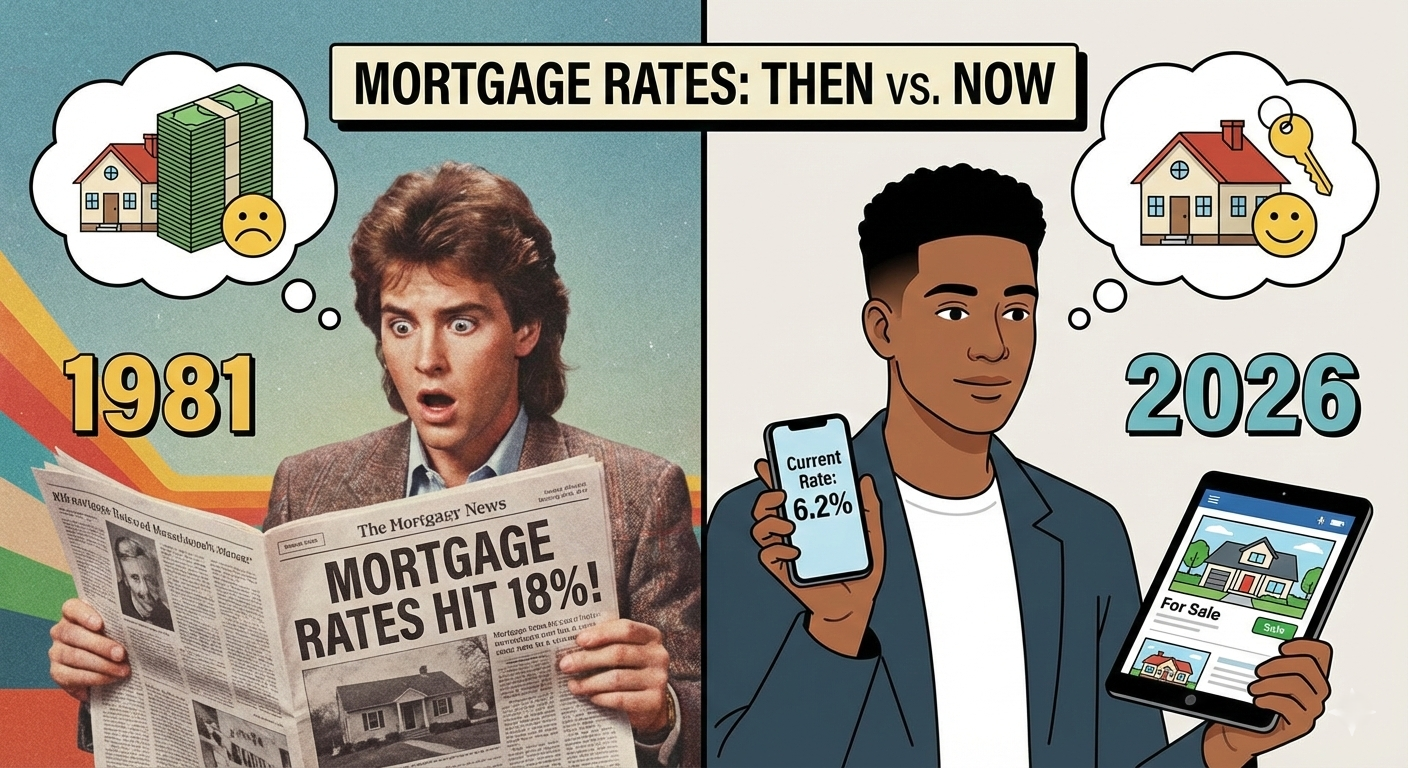
Imagine walking into a bank to apply for a mortgage, and the loan officer smiles and says, "Good news! We can lock you in at 18.6%."
You would probably laugh. Or cry. Or maybe just walk out. But if you were buying a house in October 1981, that was the reality. I talk to so many buyers in Sacramento who feel discouraged by today's rates in the 6% range. I get it. We all remember 2021. But when you zoom out and look at the big picture, the story changes completely.
We aren't in a crisis. We are just back to normal.
The "Good Old Days" (That Were Actually Terrible)
If you ask your parents or grandparents about their first home, they might tell you they bought it for $80,000. Sounds amazing, right? But they likely paid double-digit interest rates to get it.
The 1970s Economic Shift
The decade started in the reasonable 7s but ended in chaos. By 1979, inflation pushed rates to nearly 12.9%.
The 1980s Shock
This is the era that gives economists nightmares. In 1981, the average 30-year fixed rate hit an all-time high of 18.63%.
The Reality Check: A $200,000 loan at 18% interest costs $3,000 a month in interest alone. At today's 6%, that same loan costs about $1,000 in interest.
The Slow Slide Down (1990s—2010s)
After the wild ride of the 80s, things started to calm down.
The 90s saw rates drift from 10% down to 7%. Then came the 2000s and the housing crash, which pushed rates even lower, hovering between 5% and 6% for years. This is actually very similar to where we are sitting right now in January 2026!
Then came the 2010s. We got spoiled. Rates dipped into the 3% and 4% range, and a generation of buyers (maybe you!) started to believe that was the permanent standard.
The Unicorn Years: 2020—2021
This is the anomaly that messed with everyone's heads.
During the pandemic, the Fed slashed rates to keep the economy alive. We saw record lows of 2.65% in January 2021. It was essentially "free money." But here is the hard truth: That was a once-in-a-lifetime emergency event. Waiting for 2.65% to come back is like waiting to win the lottery. It might happen, but you probably shouldn't plan your financial future around it.
The 2026 Reality: Welcome to "Normal"
So, where does that leave us today?
As of early 2026, we are sitting comfortably in the low-to-mid 6s. And you know what? That is a healthy market!
- Inventory is up.
- Bidding wars are down.
- Buyers have power again.
When rates were 3%, you had to waive your inspection and pay $50,000 over asking just to get a call back. Today, you pay a little more in interest, but you get to keep your inspection contingency and actually negotiate the price.
What Should You Do?
Stop trying to time the market. You will likely miss it. Instead, focus on affordability.
- Date the Rate, Marry the House: I know it's a cliché, but it's true. If rates drop to 5% in 2027, you can refinance and lower your payment. But if you wait until 2027 to buy, home prices will likely be higher.
- Focus on the Payment, Not the Percentage: Ask your lender for a "Total Cost of Analysis." Sometimes a slightly higher rate on a home with a lower purchase price is actually cheaper long-term than a low rate on an overpriced bidding-war home.
- Run the Historical Math: Ask yourself—would you rather pay 6% on a $500,000 house today, or 5.5% on that same house when it costs $550,000 next year? The math almost always favors buying now.
Historical Real Estate Trends & Wealth Building
History teaches us that rates fluctuate, but real estate values over time almost always go up. Don't let a few percentage points scare you out of building wealth. The buyers in 1981 didn't stop buying; they just refinanced when rates dropped. You can do the same.
Curious how a 6% rate compares to your current rent payment? Drop me a message or comment below. Let's run the numbers for your favorite Sacramento zip code.
Frequently Asked Questions About Historical Mortgage Rates
Are current mortgage rates considered high historically?
No, current mortgage interest rates sitting in the low-to-mid 6% range are aligned perfectly with long-term historical norms. While significantly higher than the pandemic-era lows of 2% to 3% seen in 2020 and 2021, current rates mirror the stable baseline patterns observed across the 2000s and are vastly below the double-digit trends of the 1970s and 1980s.
What was the highest average mortgage interest rate in U.S. history?
The highest historical average for a standard 30-year fixed-rate mortgage occurred in October 1981, topping out at an all-time high of 18.63%. During this economic era, financing a home cost nearly triple the amount of monthly interest fees compared to real estate assets purchased under contemporary market structures.
Should I wait for mortgage rates to drop back to 3% before buying a home?
Waiting for interest rates to hit 3% is not recommended by real estate professionals. The 2020-2021 record lows of 2.65% were emergency anomalies caused by global financial intervention. Delaying a home purchase waiting for those metrics to reappear often costs more in long-term equity growth as home values steadily compound higher over time.
What does the phrase "date the rate, marry the house" mean?
This industry philosophy highlights that a home's physical location and purchase price are permanent variables ("the marriage"), while your mortgage interest rate is temporary ("the date"). Buying a preferred home today allows you to establish long-term equity, with the flexibility to have a rate refinance down the line if market rates decrease.